The Arthur Miller Lecture in Science and Ethics, held annually at MIT, honors the memory of Dr. Arthur Miller, an MIT alumnus (S.B. 1945) noted for his distinguished work in electronic measurement and instrumentation. During World War II, he was loaned out by the Sanborn Co. (later incorporated into Hewlett-Packard) to the Radiation Laboratory, where he worked for several years. His medical contributions included methods to reduce shock hazards in hospital monitoring systems and designing the first commercial cardiographs that featured adequate patient circuit isolation from line and ground.
The Miller Lecture has been hosted by MIT’s Program in Science, Technology, and Society for many years thanks to the generosity of Arthur Miller’s family. It is an annual event open to the entire MIT community, focusing on themes at the intersection of Science and Ethics.
2025-2026
“Landfill, Platform, Diagnosis: How People in Crisis Use Science and Technology to Build New Ethical Worlds”
Duress, or the use of force or threats to make someone do something against their will, can come in many forms. Whether it be ecocide, economic collapse, or disability, when people are under duress, their options to respond become limited. The need to survive intensifies, and people’s choices seem to narrow down to solidarity or violence.
Stamatopoulou-Robbin’s first book on waste and its infrastructures in Palestine, as well as her current book on platform-mediated home-sharing in Greece, challenge these narratives of declining countries in crisis. They show how people respond inventively to the needs of the community and the material affordances of technology and science. They respond in ways that may not make duress go away, but can remake how it works in their lives.
Science and technology are not in and of themselves solutions to the political problems that generate duress. Yet when people tinker with them, they reshape the ethical contours of their worlds in unexpected ways. This talk tells stories of old technologies (a landfill in Palestine), a newly dominant platform (Airbnb in Athens), and efforts to establish a future diagnosis in the U.S. (an autism profile called “pathological demand avoidance”) to consider the unpredictable place and light of science and technology in dark times.
About Sophia Stamatopoulou-Robbins
Sophia Stamatopoulou-Robbins is a New York-based anthropologist and Associate Professor of Anthropology at Bard College with interests in infrastructure, waste, the environment, platform capitalism, the home, and neurodivergence. She is the author of Waste Siege: The Life of Infrastructure in Palestine (Stanford University Press, 2019).
Her current book, De/tachment: Airbnb in Athens, is under contract with Duke University Press. She is beginning fieldwork on her next project on the rise of “demand avoidance” as a diagnosis and lived experience for autistic people. She has served on the editorial teams of MERIP, Cultural Anthropology, and Critical AI. More on her scholarship and films can be found here: https://sophiastamatopoulourobbins.com
2024-2025
“Campus Free Speech: A Pocket Guide”
Invited Lecturer: Cass R. Sunstein, the Robert Walmsley University Professor at Harvard University
Sunstein offers a case-by-base guide to resolving the free-speech dilemma facing colleges and universities today. The First Amendment prohibits “abridging the freedom of speech,” yet laws against perjury or bribery are still constitutional. Valuing freedom of speech does not stop a university from regulating speech when doing so is necessary for its educational mission. So where is the dividing line? How can we distinguish reasonable restrictions from impermissible infringement?
2023-2024
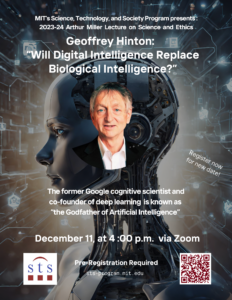
“Will Digital Intelligence Replace Biological Intelligence?”
Invited Lecturer: Geoffrey Hinton, pioneer of Artificial Intelligence and deep learning whose
conceptual and engineering breakthroughs have made deep neural networks a critical component of computing.
“Humanity is at a turning point with AI,” says Geoffrey Hinton, known as the Godfather of Artificial Intelligence. The cognitive scientist and computer scientist, who designed machine learning algorithms at Google recently quit after 10 years, will address his concerns about accelerated progress of deep learning and its potential impact on the future of humanity. AI is reshaping everything from how we write to how we engage with the world. While computers were first designed for humans to tell them what to do, they’re now learning to “think” for themselves. Join Geoffrey Hinton, AI pioneer and co-founder of deep learning, December 11th at 4 pm for a webinar, “Will Digital Intelligence Replace Biological Intelligence,” a discussion of AI and humanity’s future. Register today.
2021-2022
FASTER VACCINES: A look at the past, present, and future of our efforts to accelerate development
Guest Lecturer: Professor Kendall Hoyt, MIT HASTS ’02, Assistant Professor, Geisel School of Medicine; Senior Lecturer, Thayer School of Engineering, Dartmouth College
Prof. Hoyt teaches courses on biosecurity, health systems, and technological innovation. Her research is focused on health security, innovation policy, and vaccine development. She serves on the US Covid Commission Planning Group. She has served as a consultant for the Coalition for Epidemic Preparedness Innovations and the Nuclear Threat Initiative. She is the author of Long Shot: Vaccines for National Defense, Harvard University Press, 2012.
2019-2020
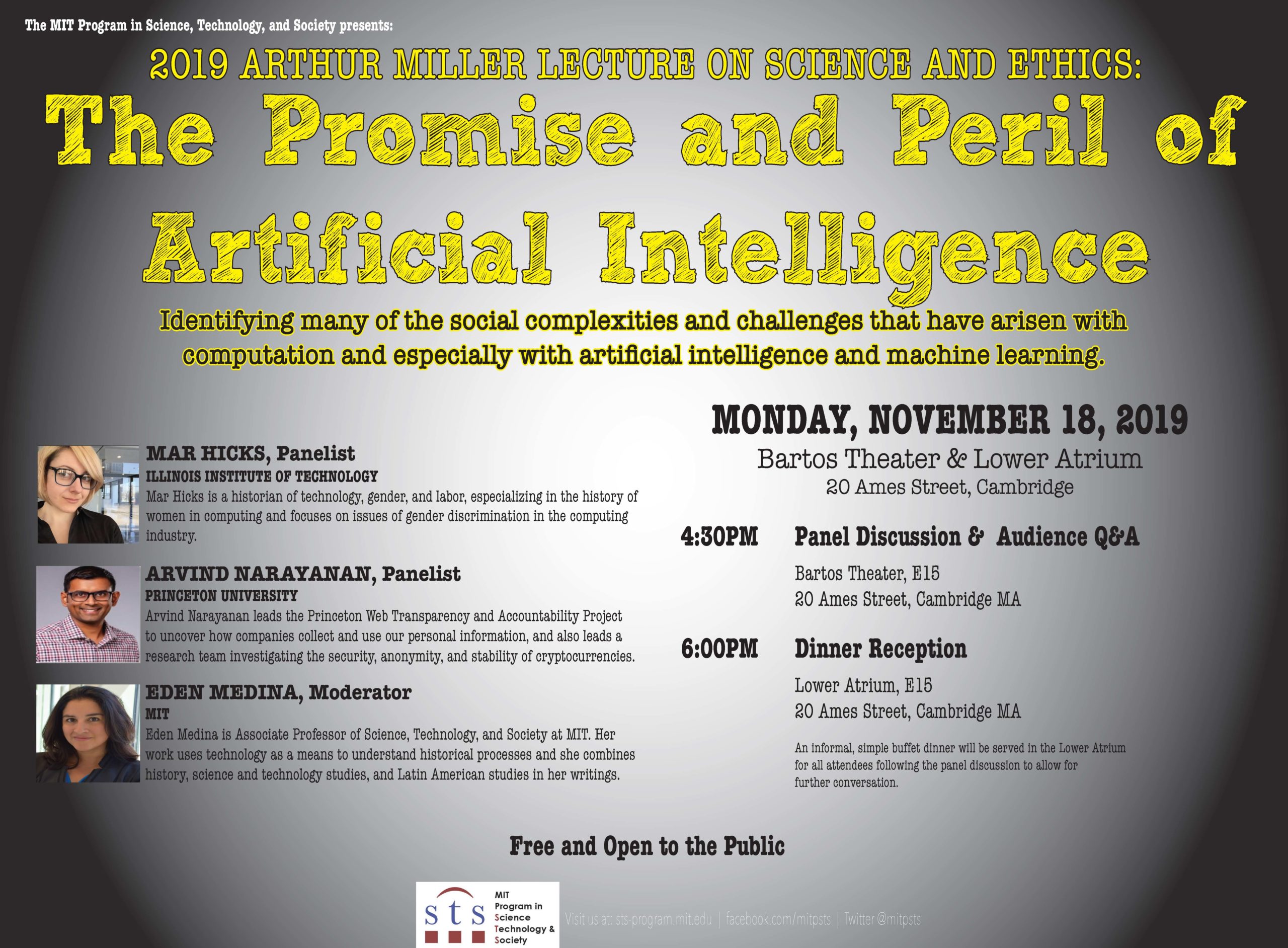
THE PROMISE AND PERIL OF ARTIFICIAL INTELLIGENCE
With a focus on the Miller Lecture’s mission to explore the humanistic, social, legal, and cultural dimensions of scientific and technological developments, this year’s lecture takes the form of a panel discussion featuring leaders in identifying many of the social complexities and challenges that have arisen with computation and especially with artificial intelligence and machinery learning.
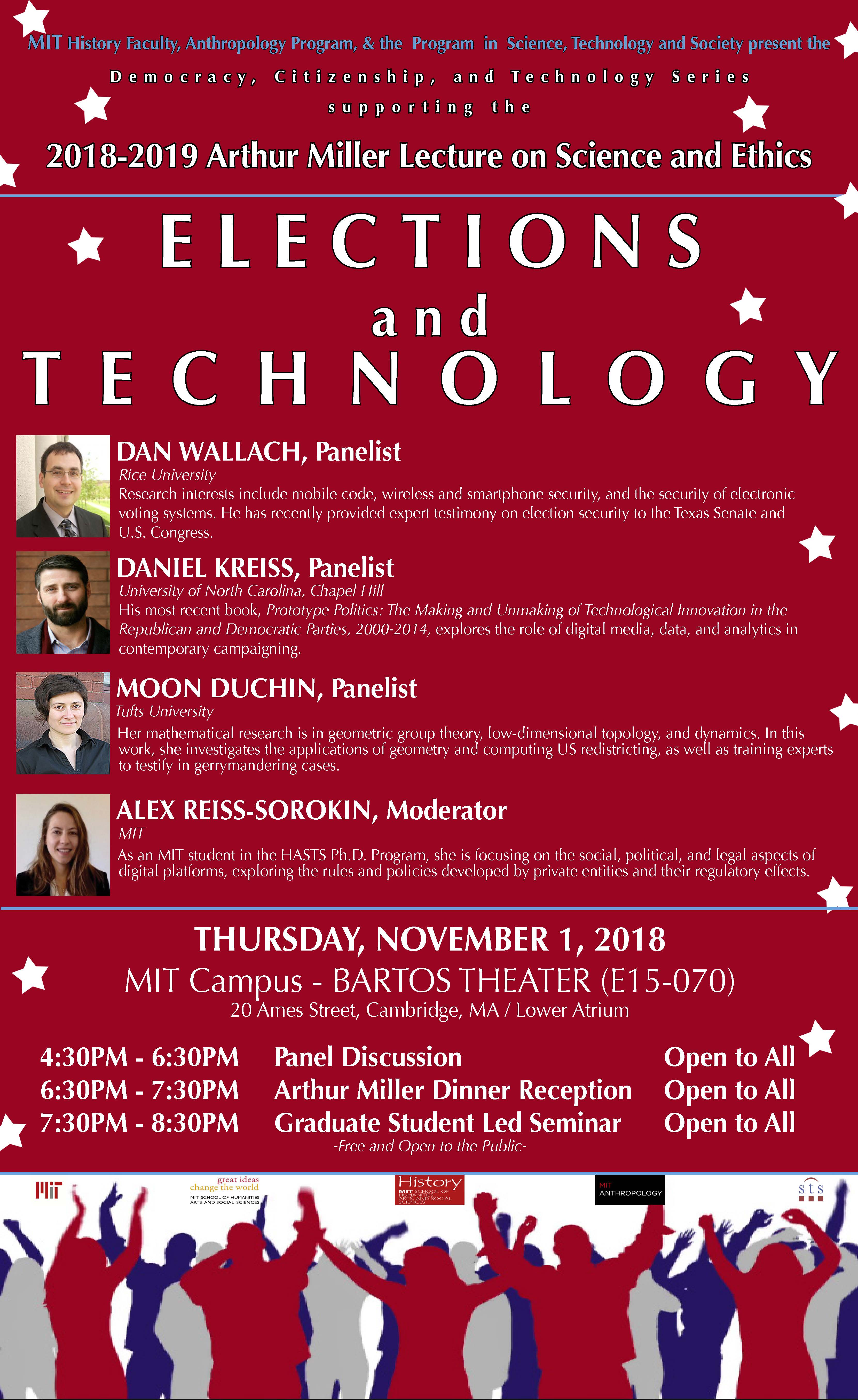
Contemporary democratic elections are increasingly technology intensive. With anxieties about the technological integrity of both American and foreign elections at an all-time high, how can researchers, policymakers, and publics better understand how technological systems are implicated in election planning, infrastructure, security, and maintenance?
The MIT programs in Anthropology, History, and Science, Technology, and Society invites the MIT and broader Boston-Cambridge communities to the second event of our Democracy, Citizenship, and Technology Colloquium Series titled Elections and Technology. This panel of multidisciplinary experts will seek to lift the curtains on three technologically mediated features of contemporary elections: the security of the electoral apparatus and infrastructure (e.g. voting machines), the intensifying role of new media technologies for influencing, mobilizing, and segmenting the electorate (e.g. social media), as well as mathematical and other means of both producing and contesting electoral gerrymandering. One week before the highly anticipated November 6th American Midterm Elections, join us for a lively panel discussion and audience Q/A session about the social and political implications of a technologically mediated electoral process.
This colloquium is part of the Arthur Miller Lecture Series in Science and Ethics hosted annually by the MIT program in Science, Technology, and Society, and is the second event of MIT’s new Computational Cultures Initiative. Following a dinner break and time for socialization, the speakers will return for a smaller seminar session offered to graduate students for a more intimate and roundtable-style discussion.
Professor in the systems group at Rice University’s Department of Computer Science where he manages the computer security lab. Dan’s research interests include mobile code, wireless and smartphone security, and the security of electronic voting systems. He has recently provided expert testimony on election security to the Texas Senate and U.S. Congress.
Daniel Kreiss, University of North Carolina, Chapel Hill
Associate Professor and Director of the School of Media and Journalism at the University of North Carolina, Chapel Hill, Daniel’s research broadly explores the impact of technological change on the public sphere and political practice. His most recent book, Prototype Politics: The Making and Unmaking of Technological Innovation in the Republican and Democratic Parties, 2000-2014, explores the role of digital media, data, and analytics in contemporary campaigning, and provides a framework for understanding the differences between the two parties’ technological capacities.
Associate Professor of Mathematics at Tufts University where she directs the Metric Geometry and Gerrymandering Group (MGGG). Moon’s mathematical research is in geometric group theory, low-dimensional topology, and dynamics. She has broad interests in the history, philosophy, and cultural studies of science. In this work, she investigates the applications of geometry and computing to U.S. redistricting, and she has facilitated workshops that train PhDs to become expert witnesses to testify in gerrymandering cases.
As a doctoral student in the HASTS program at MIT, Alex is developing a dissertation project that focuses on the social, political, and legal aspects of digital platforms. Specifically, her research explores the rules and policies developed by private entities and their regulatory effects, including the development and implementation of material internet infrastructure in the Global South.
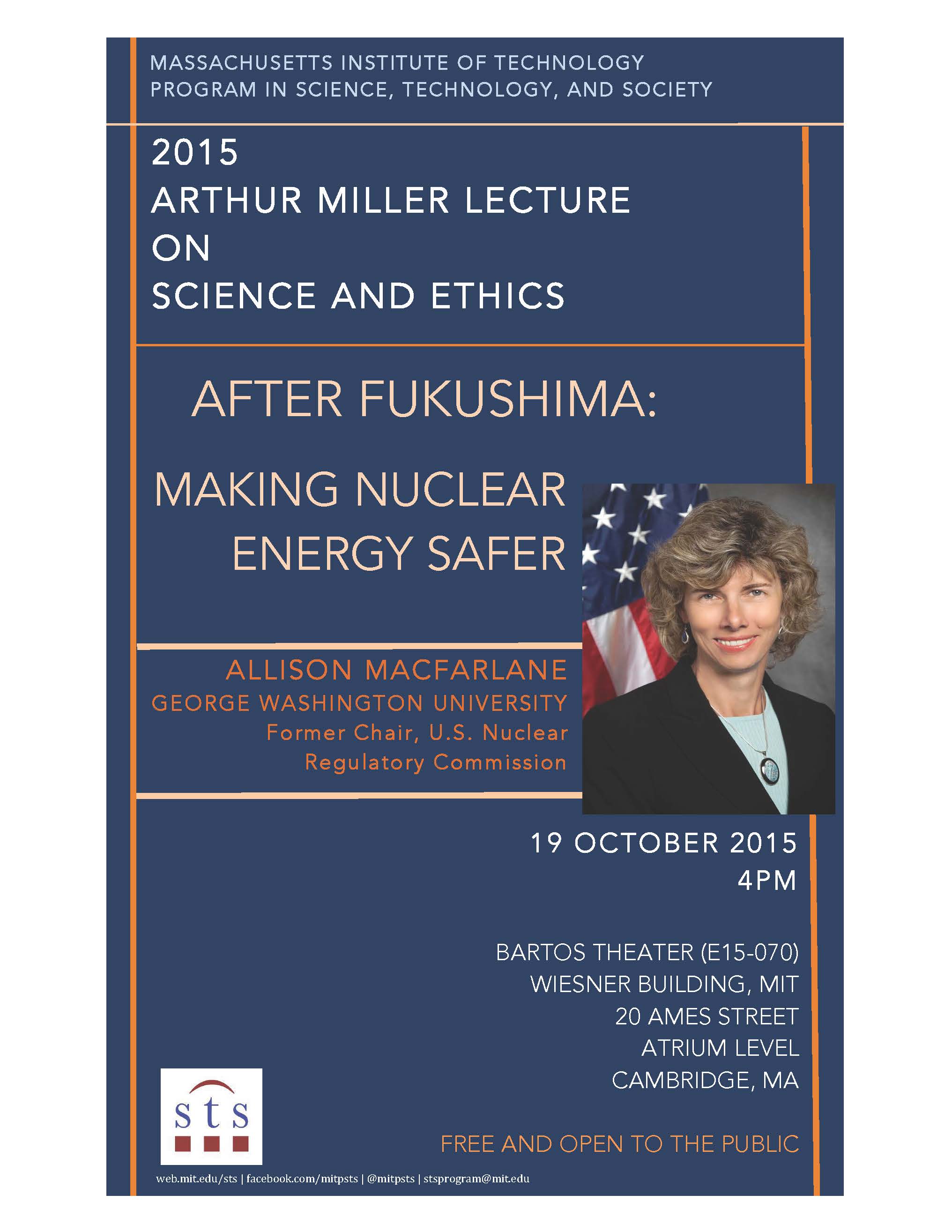
Allison M. Macfarlane is Professor of Science and Technology Policy at George Washington University and Director of the Center for International Science and Technology Policy at the University’s Elliott School of International Affairs. She recently served as Chairman of the U.S. Nuclear Regulatory Commission from July, 2012 until December, 2014. As Chairman, Dr. Macfarlane had ultimate responsibility for the safety of all U.S. commercial nuclear reactors, for the regulation of medical radiation and nuclear waste in the U.S., and for representing the U.S. in negotiations with international nuclear regulators. She was nominated by President Obama and confirmed by the Senate. She was the agency’s 15th Chairman, its 3rd woman chair, and the only person with a background in geology to serve on the Commission.
Dr. Macfarlane holds a doctorate in geology from the Massachusetts Institute of Technology and a bachelor’s of science degree in geology from the University of Rochester.
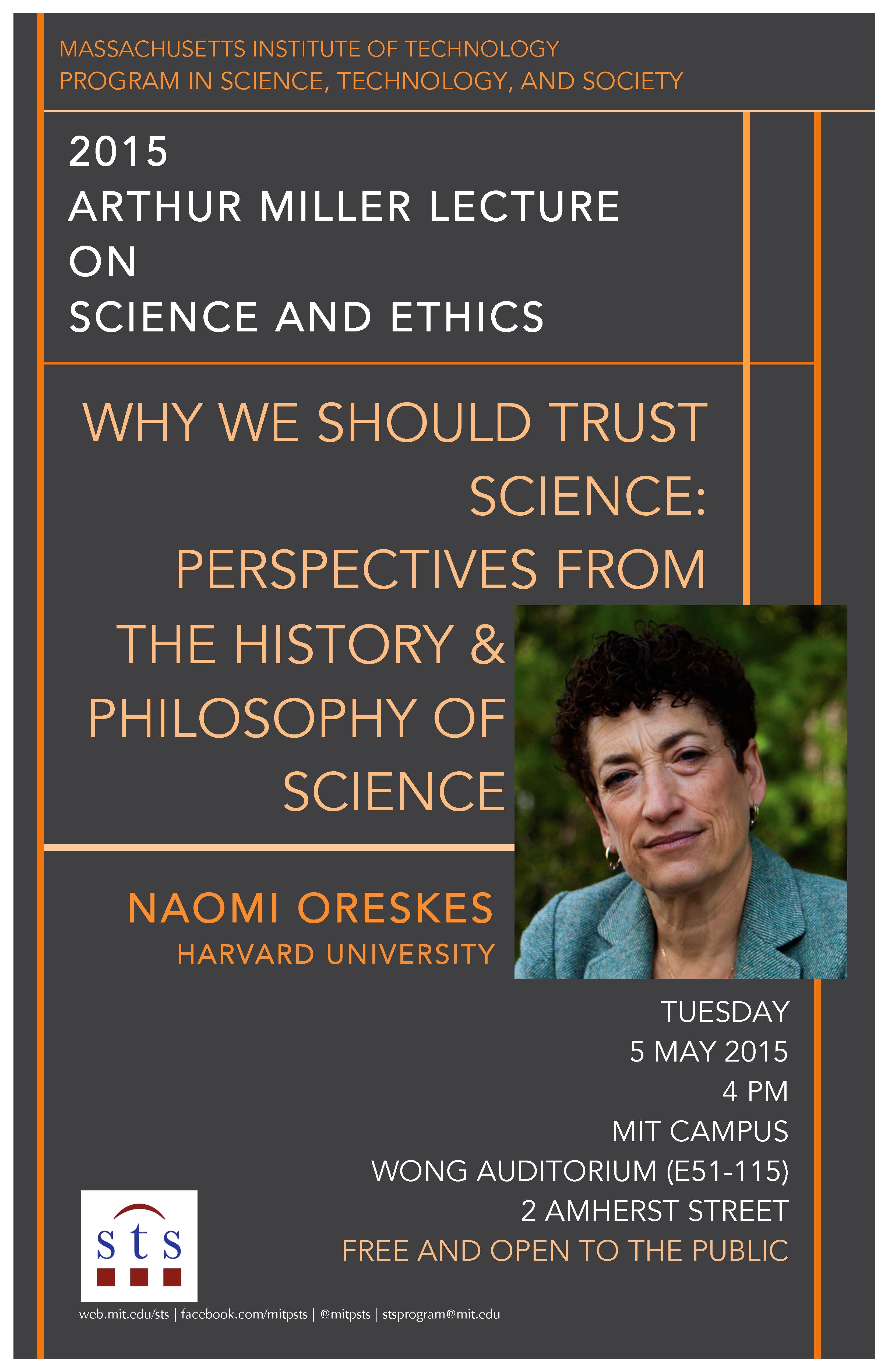
Naomi Oreskes is Professor of the History of Science and Affiliated Professor of Earth and Planetary Sciences. She recently arrived at Harvard after spending 15 years as Professor of History and Science Studies at the University of California, San Diego, and Adjunct Professor of Geosciences at the Scripps Institution of Oceanography. Professor Oreskes’s research focuses on the earth and environmental sciences, with a particular interest in understanding scientific consensus and dissent.
Her 2004 essay “The Scientific Consensus on Climate Change” (Science 306: 1686) has been widely cited, both in the United States and abroad, including in the Royal Society’s publication, “A Guide to Facts and Fictions about Climate Change,” in the Academy-award winning film, An Inconvenient Truth, and in Ian McEwan’s novel, Solar. Her opinion pieces have appeared in The Washington Post, The Los Angeles Times,The Times (London), Nature, Science, The New Statesman,Frankfurter Allgemeine and elsewhere. Her 2010 book, Merchants of Doubt, How a Handful of Scientists Obscured the Truth on Issues from Tobacco to Global warming, co-authored with Erik M. Conway, was shortlisted for the Los Angeles Time Book Prize, and received the 2011 Watson-Davis Prize from the History of Science Society.
2013-2014
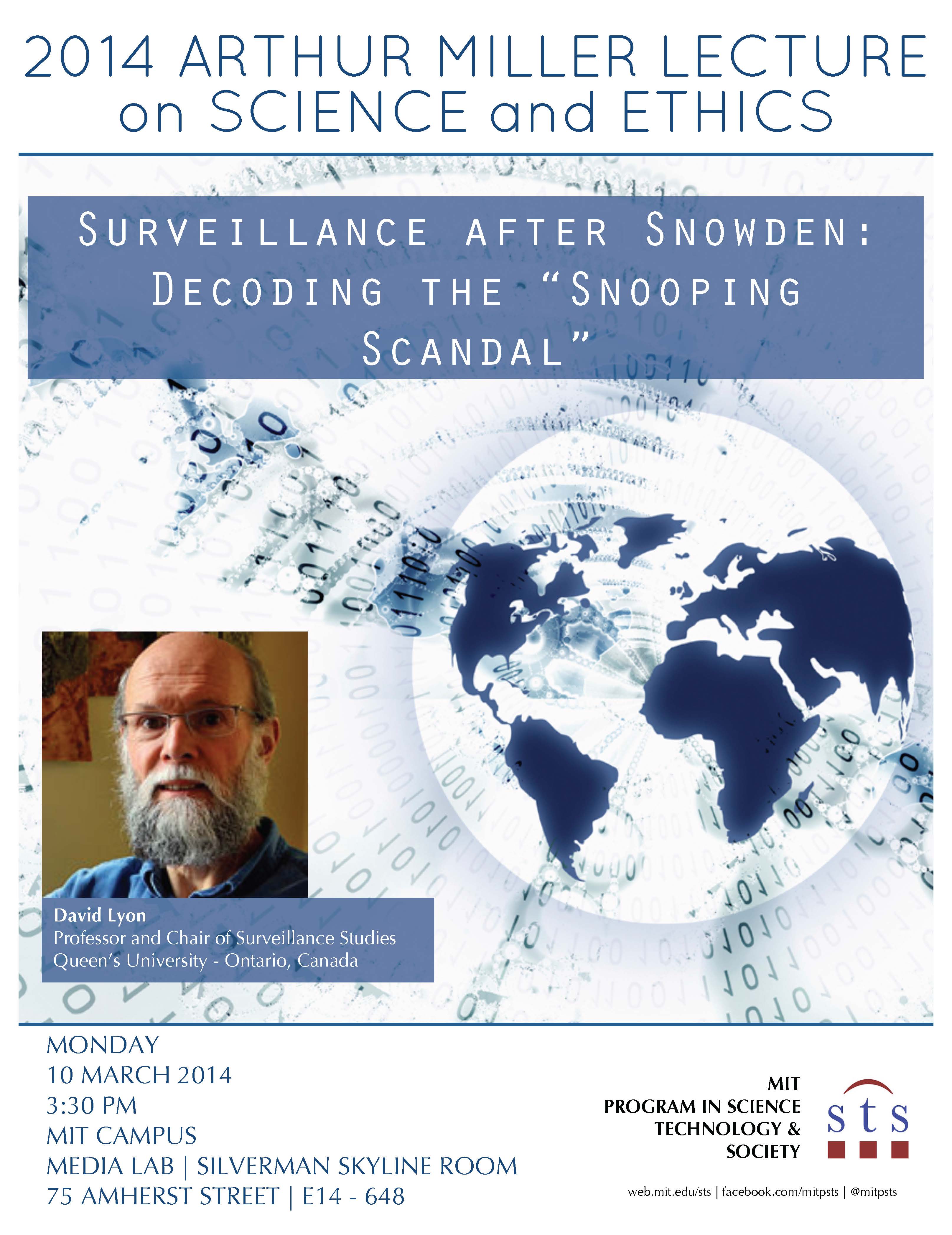
David Lyon’s research, writing, and teaching interests revolve around major social transformations in the modern world. Questions of the information society, globalization, secularization, surveillance, and debates over “post-” and “digital” modernity feature prominently in his work. Lyon was formerly an editor of Surveillance & Society and is Associate Editor of The Information Society. He also serves on the international editorial boards of several other journals. His books have been translated into seventeen languages: Arabic, Chinese, Czech, Danish, Dutch, Farsi, German, Hungarian, Italian, Japanese, Korean, Polish, Portuguese, Romanian, Spanish, Swedish and Turkish.