
Deep Forensics: A Conversation on Disappearance, Technology, and Layered Violence in Mexico
April 15 @ 4:00 pm - 6:00 pm
Event Navigation
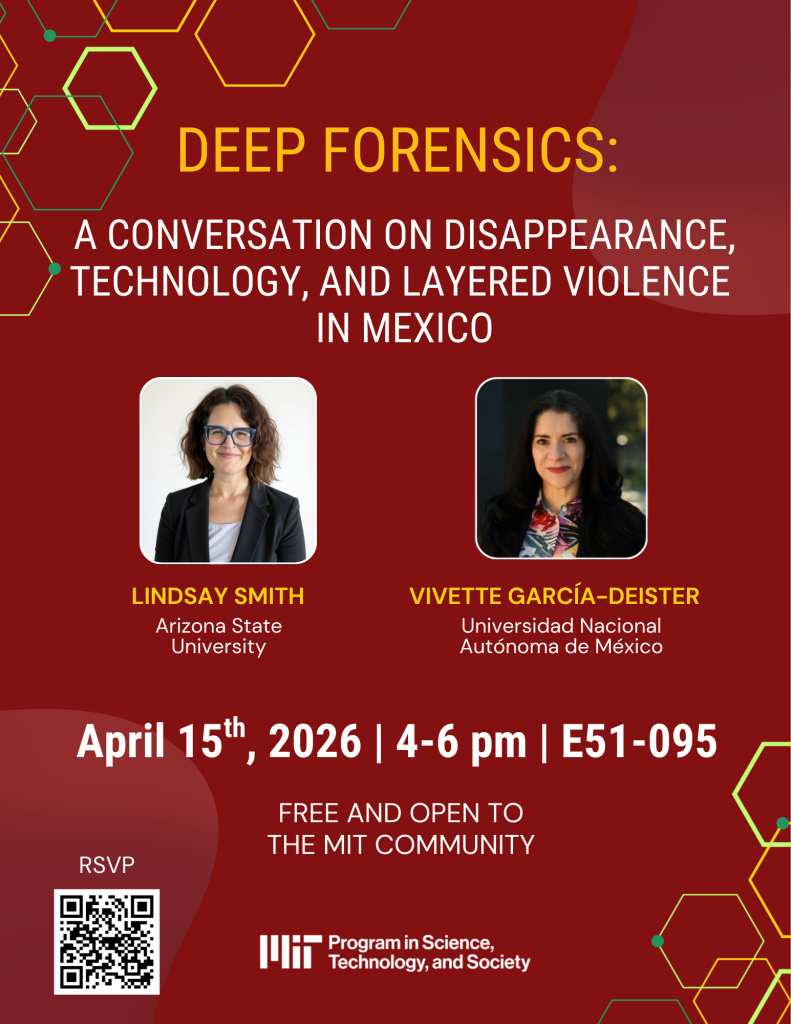
Join us on Wednesday, April 15th, from 4-6 pm in E51-095 for a special lecture with Professors Lindsay Smith and Vivette García-Deister titled “Deep Forensics: A Conversation on Disappearance, Technology and Layered Violence in Mexico.”
Speakers:
Lindsay A. Smith (Arizona State University, ASU)
Vivette García-Deister (Universidad Nacional Autónoma de México, UNAM)
Moderated by: Eden Medina (Massachusetts Institute of Technology, MIT)
Deep Forensics: A Conversation on Disappearance, Technology and Layered Violence in Mexico.
In Mexico, where more than 130,000 people are missing, and over 72,000 bodies remain unidentified, extraordinary violence has become embedded in the fabric of ordinary life. In this conversation, we bring complementary perspectives to bear on this crisis: one focused on the grassroots forensic practices of buscadora collectives —groups of family members, predominantly women and allied scientists, searching for their disappeared loved ones— and the other on the work of state experts, institutions, and practitioners deploying forensic technologies in novel and sometimes unexpected ways.
Together, we explore emergent forensic practices and technologies in Mexico and how these become entangled with —and sometimes transformative of— institutional responses to ongoing violence. A key point of convergence is the question of layered, sedimented harm and its attendant temporalities: what role can technology play in revealing forms of violence that accumulate slowly, across time and terrain? How might emergent socio-forensic assemblages provide alternative registers to address systemic entrenched harms and project long-term just futures?
About Lindsay Smith
Lindsay Smith is an Associate Professor of Science, Technology & Innovation in the Borderlands at Arizona State University’s School for the Future of Innovation in Society. Her work explores the power—and the limits—of scientific technologies in confronting impunity and violence during democratic transitions. Through long-term collaborations with human rights movements in Latin America, Smith examines how communities have reimagined emergent technologies like genetics, biometrics, and GIS—not just as forensic instruments but as ways to craft new forms of justice that challenge conventional ideas of citizen science and state authority. She leads the STSborderlands working group, an interdisciplinary network of scholars rethinking the entanglements of science, technology, colonialism, and place across the Mexican Borderlands. Her work has been published in Social Studies of Science, Science, Technology & Human Values, and American Anthropologist, among other journals in Anthropology, Latin American studies, and STS. Smith is currently completing a National Science Foundation CAREER project that investigates hybrid technologies of migration—technologies that operate at the nexus of surveillance and human rights in the U.S.-Mexico border region.
About Vivette García-Deister
Vivette García Deister has a PhD in Philosophy of Science from UNAM, or the National Autonomous University of Mexico. Using ethnographic methods, transnational history, and philosophy of science in practice, she studies the relationships between science, technology, and society. She analyzes the developments of biomedical and forensic genetics and their impact on health, racism, and justice in Mexico. Vivette is the Editor-in-Chief of the journal Tapuya: Latin American Science, Technology and Society. She has published two books, dozens of research and outreach articles and chapters, and has written for Slate, Este País, Animal Político, Cronopio, and Letras Libres.
To Attend In-Person
Please fill out this RSVP form if you plan to attend
This event is in-person only