What new perspectives about the history and practice of science, technology, and medicine emerge when we foreground the intellectual labor of thinkers and practitioners from the Global South? Dwaipan Banerjee’s work centers the lives and creative visions of scientific practitioners in South Asia, challenging scholars to reorient how we understand the past and future of science, technology, and medicine. Spanning health and medicine, pandemics, biological materials, and computing, this research is ultimately driven by his commitment to envisioning more expansive geographies for science and technology studies.
Professor Banerjee’s approach investigates new imperial formations as well as postcolonial orientations in science and technology studies.
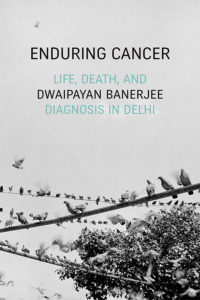
His first book, Enduring Cancer: Life, Death and Diagnosis in Delhi (Duke University Press, 2020), is an ethnography of cancer in India that presents the efforts of the urban poor in Delhi to carve out a livable life with cancer as they negotiate an over-extended health system. Through ethnographic fieldwork, archival research, and analyses of cultural texts, this book describes how cancer shapes and is shaped by local social worlds. The ethnography reveals how, for most of Delhi’s urban poor, a cancer diagnosis came too late for curative intervention, becoming the latest in a series of infrastructural failures. The book argues that to live with or alongside cancer is to be newly awakened to the fragility of social ties, examining how the disease nestled into or tore apart already fragile kinship relationships and why many spoke indirectly or not at all about the disease to those closest to them.
Professor Banerjee’s second book, Hematologies: The Political Life of Blood in India (Cornell University Press, 2019), co-written with anthropologist Jacob Copeman, examines how blood donation has shaped social and political life in north India. The book traces how blood congeals political ideologies, biomedical rationalities and activist practice—from anti-colonial appeals to blood sacrifice to contemporary portraits of political leaders drawn with blood, from Bhopali children using blood as activist material to biomedical anxieties about donation. The book reveals the dynamic relation between practices that reproduce blood as a boundary-marking substance and those that reimagine it as transcending imperatives of kin, caste and religion.
His forthcoming book, Computing in the Age of Decolonization: India’s Lost Technological Revolution (Princeton University Press, 2026), uncovers India’s ambitious but ultimately thwarted drive to build a self-reliant computing industry from the 1950s to the 1980s. After independence, Indian scientists at institutions like the Tata Institute of Fundamental Research saw computing as central to national sovereignty. Through projects such as the TIFRAC computer and IBM’s expulsion, they aimed for technological independence. But these initiatives faced powerful headwinds as computer scientists grappled with Cold War politics, trade imbalances, corporate monopolies, and strategic decisions by India’s technocratic elite, who favored profitable technical services over costly research investments.
Professor Banerjee’s research has been funded by the National Science Foundation, Mellon Foundation, Wenner-Gren Foundation, Social Science Research Council, and other institutions. His film The Beloved Witness on Kashmiri poet Agha Shahid Ali was nominated for Best Short Documentary at the New York Indo-American Film Festival. He earned his doctorate in cultural anthropology at NYU and has been a Mellon Postdoctoral Fellow at Dartmouth College, and holds an M.Phil and MA in sociology from the Delhi School of Economics.
To learn more about Dwai Banerjee’s research, please visit his website: dwaibanerjee.com
To learn more about his upcoming book, “Computing in the Age of Decolonization: India’s Lost Technological Revolution”, please visit this site: https://press.princeton.edu/books/hardcover/9780691268217/computing-in-the-age-of-decolonization