Faculty & Student Mentions, News
Professor Kate Brown’s MITHIC Course Featured in MIT News – Returning Farming to City Centers
Nov 20, 2025
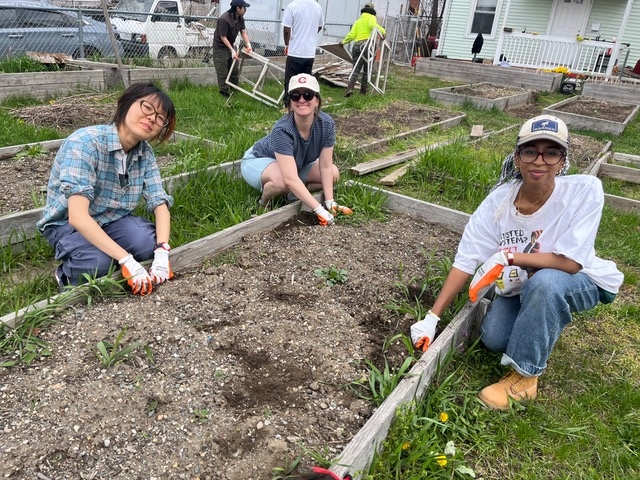
Left to right: Students Kaidi Liu, Zaynab Eltaib, and Olivia Fiol work a plot of urban farmland at The Common Good Co-Op.
A new class is giving MIT students the opportunity to examine the historical and practical considerations of urban farming while developing a real-world understanding of its value by working alongside a local farm’s community. Course 4.182 (Resilient Urbanism: Green Commons in the City) is taught in two sections by instructors in the Program in Science, Technology, and Society and the School of Architecture and Planning, in collaboration with The Common Good Co-op in Dorchester. The first section was completed in spring 2025 and the second section is scheduled for spring 2026. The course is taught by STS professor Kate Brown, visiting lecturer Justin Brazier MArch ’24, and Kafi Dixon, lead farmer and executive director of The Common Good.
“This project is a way for students to investigate the real political, financial, and socio-ecological phenomena that can help or hinder an urban farm’s success,” says Brown, the Thomas M. Siebel Distinguished Professor in History of Science.
Community development, investment, and collaboration
The class’s first section paired students with community members and the City of Boston to change the farm’s zoning status and create a green space for long-term farming and community use. Students spent time at Common Good during the course, including one weekend during which they helped with weeding the garden beds for spring planting.
One objective of the class is to help Common Good avoid potential pitfalls associated with gentrification. “A study in Philadelphia showed that gentrification occurs within 1,000 feet of a community garden,” Brown says.
“Farms and gardens are a key part of community and public health,” Dixon continues.
The intersection of agriculture, community, and technology
Technology, the course’s participants believe, can offer solutions to some of the challenges related to ensuring urban farms’ viability.
“Cities like Amsterdam are redesigning themselves to improve walkability, increase the appearance of small gardens in the city, and increase green space,” Brown says. By creating spaces that center community and a collective approach to farming, it’s possible to reduce both greenhouse emissions and impacts related to climate change.
Additionally, engineers, scientists, and others can partner with communities to develop solutions to transportation and public health challenges. By redesigning sewer systems, empowering microbiologists to design microbial inoculants that can break down urban food waste at the neighborhood level, and centering agriculture-related transportation in the places being served, it’s possible to sustain community support and related infrastructure.
“Community is cultivated, nurtured, and grown from prolonged interaction, sharing ideas, and the creation of place through a shared sense of ownership,” Bailey argues. “Urban farms present the conditions for communities to develop.”
You can read the full article here.